Does 'As-Is' Mean No Warranty? (What the Window Sticker Is Actually Telling You)
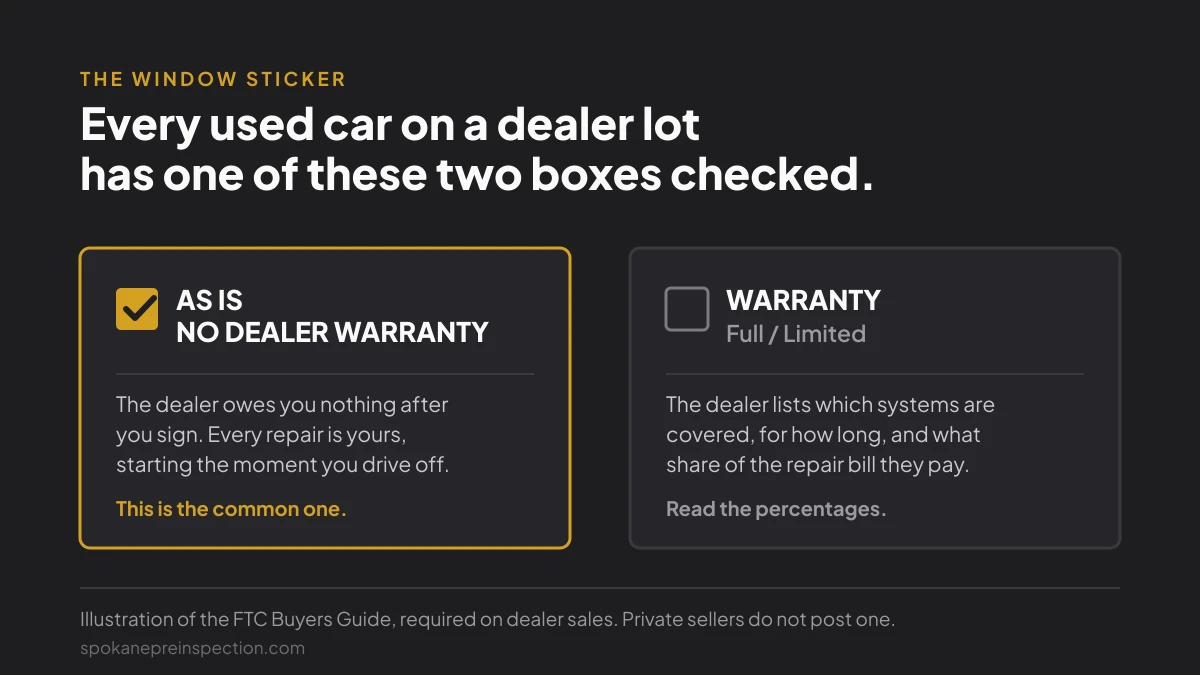
“AS IS - NO DEALER WARRANTY.”
If you have looked at a used car on a dealer lot, you have seen that box. It sits on a form taped inside the window, next to a second box that almost never gets checked.
The short answer to the question in the title is yes, usually. As-is means no warranty from the person selling you the car.
The longer answer is the one worth reading, because what you give up depends entirely on who you are buying from. A dealer and a private seller are handing you two different deals, and the paperwork that proves it is different too.
The Form in the Window
Federal law requires used car dealers to display a Buyers Guide on every vehicle they offer. It comes from the FTC’s Used Car Rule, and it applies to anyone selling more than a handful of used vehicles a year. Private sellers are exempt, which matters more than it sounds and we will come back to it.
The Buyers Guide has two boxes. One of them is checked.
Box one: AS IS - NO DEALER WARRANTY. The dealer takes no responsibility for anything that happens after you sign. Every repair is yours from the moment you drive away.
Box two: WARRANTY. The dealer names which systems are covered, for how long, and what percentage of the parts and labor they will pay.
Two details about this form are worth knowing, and most buyers know neither.
The Buyers Guide becomes part of your contract. If the sticker says the powertrain is covered for 30 days and the sales contract you sign says otherwise, the Buyers Guide wins. The FTC wrote it that way on purpose.
You are entitled to take it with you. The dealer has to give you the actual Buyers Guide from the window, or a copy of it, at the time of sale. Ask for it. If it turns out you need to prove what you were promised, that piece of paper is the proof.
Dealer or Private Seller Changes the Answer
This is the part that trips people up, and it is the reason “does as-is mean no warranty” has more than one correct answer.
Buying from a dealer
A dealer is a merchant, and merchants come with a warranty attached by default. It is called the implied warranty of merchantability, and it means the thing you bought should do what that kind of thing normally does. A car should start, run, steer and stop.
You never signed anything to get that warranty. It comes with the transaction automatically under commercial law as Washington has adopted it.
Checking the as-is box is how a dealer takes it back. That is the entire function of the box. It is a disclaimer, and it converts a sale that would have carried a baseline guarantee into one that carries none.
So a dealer selling you a car as-is is taking back a guarantee you already had. Twenty minutes earlier, before you saw which box was checked, that car came with a floor under it.
Buying from a private seller
A private seller was never a merchant, so there was no implied warranty of merchantability to begin with. There is nothing for them to disclaim.
This means a private sale is effectively as-is whether or not anyone says the words, writes them on the bill of sale, or knows what they mean. There is no Buyers Guide because the FTC rule does not reach private sellers. There is no box to check.
People find this backwards. The seller with the paperwork and the disclosures and the federal form is the one who had something to take away. The guy meeting you in a parking lot with a handwritten bill of sale never had it in the first place.
What “As-Is” Never Takes Away
As-is limits what you can expect. It does not license the seller to lie to you.
Washington’s Consumer Protection Act still applies to deceptive practices in a vehicle sale. Odometer tampering is a federal crime regardless of what any sticker says. Concealing a salvage or rebuilt title, or answering a direct question about accident history with a lie, is fraud and as-is does not cure it.
We covered the fraud side in detail in what “as-is” really means when buying a used car, so we will not repeat it here.
What is worth adding is the practical limit. Proving that a seller knowingly lied requires evidence, and evidence usually requires a lawyer, and a lawyer usually costs more than the transmission. The protection is real. It is a bad plan to rely on.
Who Pays When You Find a Defect
You. In an as-is sale, you pay.
That is true whether the problem showed up on day two or day sixty, whether it costs $300 or $4,000, and whether the seller knew about it or not. If they did not know, as-is covers them. If they did know and said nothing when you asked directly, you are back in fraud territory and back to needing evidence.
There is no cooling-off period on a vehicle purchase in Washington. There is no three-day window, no return counter, and the Lemon Law is aimed at new vehicles rather than used ones. Two other posts cover those in full: the no-return law for used cars in Washington and why the Lemon Law will not protect your used car purchase.
The pattern across all three is the same. Washington puts the responsibility on the buyer, before the signature, every time.
Before You Sign
Since the warranty question is mostly settled the moment you sign, everything useful happens earlier.
1. Read the box, then take the form
Look at which box is checked before you talk about price. If it says AS IS - NO DEALER WARRANTY, you now know the repair budget is entirely yours and you can negotiate accordingly. Take the Buyers Guide with you when you leave.
2. Treat a checked warranty box as a starting point, not an answer
“90 days / 50% parts and labor” sounds like coverage. Work out what it excludes. Most limited dealer warranties cover the powertrain and skip the expensive electrical and emissions work that tends to fail on a ten-year-old car.
3. Get any promise onto the form
If the salesperson offers to fix the brakes before delivery, that promise is worth exactly nothing spoken. Write it on the Buyers Guide or into the purchase agreement. Verbal commitments do not survive an as-is sale.
4. Inspect before you sign, not after
An inspection is the only thing on this list that puts trained eyes on the car while you can still change your mind. No inspection catches everything, and anyone who tells you otherwise is selling something. What it does is move most of the surprises forward, to a point where they are still the seller’s problem to explain and yours to price.
At $225 against a repair bill that routinely runs into the thousands, it does not have to catch everything to be worth doing.
5. Walk if you are told no
A seller who will not allow an independent inspection has told you something about the car. Believe them.
The Real Trade
A warranty pays for a repair after it happens. An inspection gives you a chance to find the repair before you own it. Those are not equivalent goods, and the second one is worth more at the moment you are deciding.
A dealer warranty might reimburse half the cost of a water pump in month two. A seeping water pump is also the sort of thing an inspection tends to catch in week zero, while you still have the option to ask for $600 off or walk to the next car on the lot.
As-is is hardest on buyers who did not look at all. If you looked, you have a far better idea what you are taking on, and the box on the window is confirming something you already priced in.
Frequently Asked Questions
Does as-is mean no warranty at all?
From the seller, yes. As-is means the seller makes no promises about how the car performs after the sale. A separate third-party or manufacturer warranty can still exist on the vehicle, and a remaining factory powertrain warranty may still transfer, so ask.
What does “AS IS - NO DEALER WARRANTY” mean on a Buyers Guide?
The dealer is disclaiming responsibility for repairs after you take delivery. It also disclaims the implied warranty of merchantability that would otherwise apply to a merchant sale. That checkbox is doing real legal work.
Is a private seller allowed to sell a car as-is in Washington?
Yes, and a private sale is effectively as-is by default. Private sellers are not merchants, so no implied warranty of merchantability applies, and the FTC Buyers Guide requirement does not reach them.
Can I sue if I bought a car as-is and it broke?
Not for the breakdown itself. As-is means you accepted the car in its condition at the time of sale. You may have a claim if you can prove the seller knowingly misrepresented something material, which is a fraud question rather than a warranty question, and it requires evidence.
Does Washington have a statutory warranty on used cars?
No. Washington does not impose a mandatory warranty period on used vehicle sales. The implied warranty of merchantability applies to dealer sales unless disclaimed, and the as-is box is how it gets disclaimed.
Who is responsible if I find a defect after buying a car as-is?
You are, in almost every case. The exception is a defect the seller knew about and actively concealed or lied about when asked, which moves the situation from warranty into fraud.
Should I pay extra for a dealer warranty instead of an inspection?
Get the inspection first. A warranty pays part of a repair bill later. An inspection gives you a chance to find the problem while you can still negotiate the price or walk away. Neither one is a guarantee, and they are useful at different moments.
As-is is the default in the used car market, and it is not going to change. Nearly every used vehicle in Washington sells this way, and most of those sales work out fine for the buyer.
What separates the buyers who do fine from the ones who get hurt is rarely the box on the window. It is how much they knew about the car before they signed for it.
We inspect used vehicles across Spokane, at the dealer lot or the seller’s driveway, before the paperwork happens. $225, and you get what we found in writing while you still have every option open.
This is general information about how used car sales work in Washington, not legal advice. If you believe a seller defrauded you, talk to an attorney.
About the Author
John Coleman
Founder, Spokane Preinspection
I started Spokane Preinspection with one goal: make buying a used car easier, faster, and more fair. Every inspection we do puts real information in buyers' hands so they can make confident decisions.
Learn More About Us →Ready to Buy or Sell With Confidence?
Book a professional pre-purchase inspection and know exactly what you're dealing with.
Book Inspection